

Since 1991, the magazine EIKON has dealt with Austrian and International artists in the field of photography and media art. Quarterly, with an average of 100 pages, the international magazine offers well-founded articles in German and English alongside extended picture spreads.
——-
release date: 23 Feb 2023
(Magazine ships from Austria in 5-12 working days)
Already used in various ways by the ancient oriental civilizations, the fossil raw material petroleum advanced to become a ubiquitously used resource with the beginning of the industrial age, which is still used today not only as a fuel for combustion engines and for energy generation, but also forms the basis of countless everyday products - from clothing to plastic (packaging) to medicines. Today, however, we are confronted with the downside of this petroculture, which once enabled mankind to make so much supposed progress and which went hand in hand with seemingly endless economic growth: The consequences of ruthless exploitation, unrestricted mobility, insatiable production of ever more consumer goods while at the same time neglecting the fact that all the emissions and products produced are de facto non-degradable, are currently melting polar ice caps, causing freshwater sources to dry up, polluting oceans, in short: destroying our planet.
Ernst Logar has been studying crude oil since a working visit in 2008 to Aberdeen - a port metropolis in northeast Scotland dominated by the oil industry, with dozens of offshore platforms. A research project currently based at the University of Applied Arts Vienna (Department of Site-Specific Art) and initiated by the artist, Reflecting Oil: Arts-Based Research on Oil Transitions, reflects from an artistic perspective the different facets that arise from the extraction of crude oil as the basis of our contemporary society. A first report of the colloquium, which was realized with the involvement of interdisciplinary actors and whose synopsis will also be published in book form one year later, is presented in this issue's eponymous focus with a text by Alejandra Rodríguez-Remedi. (Nela Eggenberger for EIKON, February 2023)
VISIT OUR EIKON COLLECTION OF MAGAZINES

Since 1991, the magazine EIKON has dealt with Austrian and International artists in the field of photography and media art. Quarterly, with an average of 100 pages, the international magazine offers well-founded articles in German and English alongside extended picture spreads.
The present issue focus, which Pia Draskovits designed for EIKON and which traces the most important stages in Inge Morath's life, is also intended to pay homage to the work of the extraordinary photographer on the occasion of the anniversary.
(Please allow 1-2 weeks for shipping)
EIKON #122 (Juni 2023)
Künstler:innen | Farah Al Qasimi | Judith Fegerl | Philipp Fleischmann | Peter Weibel
IM FOKUS | Inge Morath
Sprachen | Deutsch / Englisch
Format | 280 x 210 mm
ISBN | 978-3-904083-15-7
96 Seiten
Almost 100 years ago to the day, Inge Morath was born in Graz. To honor this milestone birthday, the Magnum photographer's work will be negotiated throughout 2023 in various exhibitions (with a focus on her temporary home in Salzburg) and new publications; much of it under the auspices of the Fotohof, which has made a special contribution to publicizing Morath's work in her former homeland (and which, logically enough, resides in the Inge Morath Square in Salzburg's Lehen district, which it itself created).
Inge Morath, who was actually trained as a linguist and translator, initially worked as an editor for various periodicals before she first took up the camera in the early 1950s under the influence of Henri Cartier-Bresson and his precise image composition. Her first major assignments followed shortly thereafter, taking her to various metropolises around the globe. In addition to the commissioned work for the Magnum photo agency, Morath pushed free photographic projects on her numerous travels, with which she could devote herself to her personal interests beyond the mainstream. At the same time, her photographs also testify to "her empathy, her lack of narcissism, her curiosity about other human beings and cultures, her hope that art could be a candle against the darker elements of human nature," as her daughter Rebecca Miller puts it in the preface to the opulent volume Inge Morath. Hommage (Schirmer/Mosel, 2022) describes.
VISIT OUR EIKON COLLECTION OF MAGAZINES
Since 1991, the magazine EIKON has dealt with Austrian and International artists in the field of photography and media art. Quarterly, with an average of 100 pages, the international magazine offers well-founded articles in German and English alongside extended picture spreads.
(Please allow 1-2 weeks for shipping)
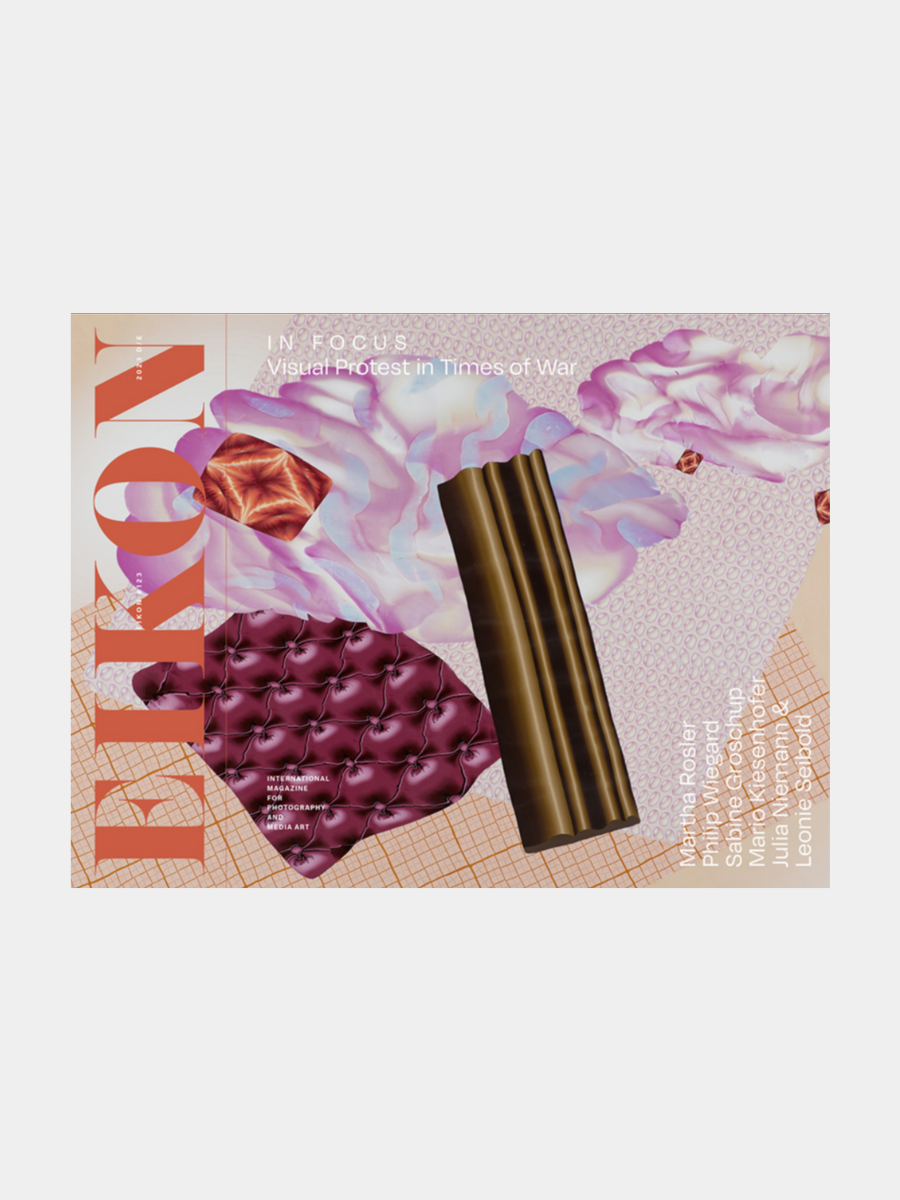
Since its beginning on February 24, 2022, the Russian attack on Ukraine has - rightly, of course - first and foremost focused the eyes of the world public on the victims of the war, i.e. on the countless Ukrainians who were confronted with a suddenly completely changed living situation and were forced to flee or to hold out under the most adverse circumstances. Some countries in solidarity with Ukraine, which were able to provide the funds, have made special efforts to establish support for artists, including Austria with the project "Office Ukraine - Shelter for Ukrainian Artists", which sees itself as a contact point for artists from the attacked country and provides a platform for their art.
On the other hand, regime-critical artists from Russia and Belarus, the "perpetr:ing countries" that fuel this war, have a doubly difficult time: despite their open protest against the authoritarian systems of their states, they are unwelcome in the West in view of their origins. In their home countries, on the other hand, they can feel less safe than ever because of their political views. Basically, their situation is comparable to that of stateless persons - with the difference that at least no one is interested in them, a state of insignificance that many Russians and Belarusians would like to see.
Thanks to the commitment of Simon Mraz, long-time observer of the Russian cultural space and author of this year's focus "Visual Protest in Times of War", in times of rather uniform reporting, the publications of Lesia Pcholka and Alyona Malkowskaya now also give journalistic space to the internal view.
Nela Eggenberger for EIKON, September 2023
VISIT OUR EIKON COLLECTION OF MAGAZINES
Follow Eikon on Instagram
gallery


